
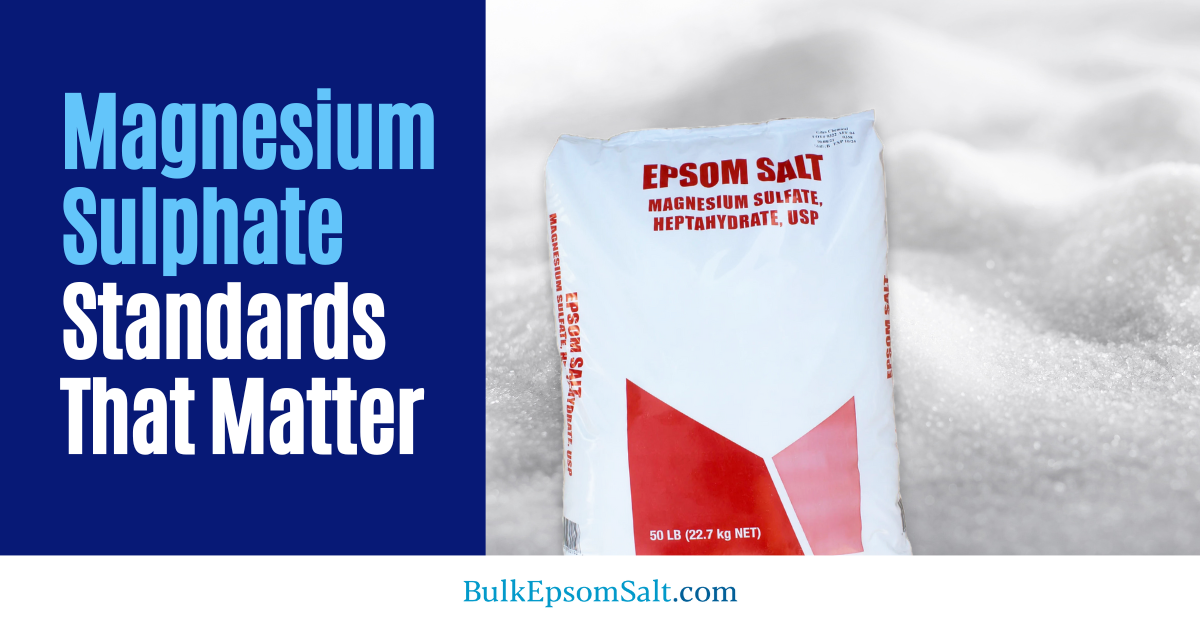
Magnesium sulphate epsom salt is used every day in commercial settings where quality cannot slip.
This is why businesses that rely on this mineral need clear standards to protect their products, processes, and customers.
When sourcing for large or regulated uses, small differences in purity and testing can lead to big problems down the line.
Commercial buyers often focus on price and availability first, which makes sense at scale. But without clear standards, those savings can disappear fast.
Poor consistency can cause equipment issues, failed audits, or unhappy clients.
Understanding grades, documentation, and testing helps you avoid these risks and keep operations running smoothly.
Magnesium Sulphate Epsom Salt Purity Standards
Purity is the starting point for any commercial order, as it tells you how much of the product is actually magnesium sulphate and how much is not. For business use, that difference matters.
Lower purity material may contain excess moisture, heavy metals, or unwanted minerals, which can affect performance and safety.
In high-volume systems, small impurities can build up over time and damage tanks, clog filters, or change product results.
 Different industries require different purity levels.
Wellness centers using an epsom salt float tank need a predictable mineral content to maintain water balance, while agricultural businesses need consistency to meet their own specs.
Purity is usually defined by a standard or grade. This might be USP, technical, or another recognized classification.
Each one has a clear set of limits and requirements, so it is important to always know which grade they are purchasing and why it fits their use.
Never assume purity based on appearance alone. Epsom salt can look the same across grades.
Only testing and documentation can confirm what you are getting.
This is why we at BulkEpsomSalt.com provide a Certificate of Analysis or COA upon request for our clients’ peace of mind.
Call or text us to learn more or place an order.
Epsom Salt Grade Classifications Explained
Grades exist to match material to its intended use. They also protect you from using the wrong product in the wrong setting.
USP Grade epsom salt is commonly used where human contact is expected, as it follows strict rules for purity and contaminants.
This grade is often required for personal care, wellness, and some regulated environments.
On the other hand, technical or industrial grades are used where those limits are not required.
These grades may still work well for certain applications, but they may not meet the standards needed for regulated operations.
You should also consider particle size and moisture content, as these affect how the product dissolves.
A bulk epsom salt 50 lb bag must pour, store, and dissolve the same way every time. Inconsistent size or excess moisture can slow production and create waste.
Grade labels should be backed by real data.
A supplier should be able to explain how the product is classified and what standards it meets. Vague terms or missing details are red flags.
Choosing the right grade is not about buying the highest option—it is about buying the correct one for your process and compliance needs.
Documentation And Testing That Protect Your Business
Paperwork matters as much as the product itself. Documentation proves that the material meets its stated standards and protects your business during audits or customer reviews.
A COA is one of the most important documents, as it shows test results for purity, moisture, and impurities.
 It should match the batch you receive. Outdated or generic certificates do not provide real protection.
Testing protocols should also be consistent. Reputable suppliers test each lot or follow a defined schedule, which ensures that quality does not change between shipments.
For repeat buyers, this consistency supports stable operations and forecasting.
Compliance records also help answer customer questions.
If your clients ask where you get epsom salt that meets certain standards, you need proof. Clear documentation builds trust and reduces risk.
This is especially important when sourcing from a magnesium sulfate supplier that serves multiple industries.
Strong records show that the supplier understands compliance and takes quality seriously.
Bulk Epsom Salt Supply For Commercial Use
You need more than a good product—they need a reliable supply. Standards help ensure that every shipment matches the last one.
Consistency matters when ordering large volumes or frequent shipments, whether you’re searching for bulk epsom salt near you or looking to order from somewhere far.
Sudden changes in quality can disrupt production or service schedules.
Clear standards also help with logistics. Proper labeling, packaging, and lot tracking reduce errors and make storage safer and handling easier across warehouses and facilities.
Ask how suppliers manage scale. This includes sourcing, storage, and quality checks.
A strong system supports long-term growth without sacrificing standards.
Knowing where to get epsom salt that meets your needs saves time and cost over the long run. It also reduces the need for rework, returns, or emergency sourcing.
Order Bulk Epsom Salt Online Today
In the end, magnesium sulphate epsom salt standards are about control and confidence. They protect your equipment, your customers, and your reputation.
When purity, grades, and records are clear, you can scale without surprises.
We at BulkEpsomSalt.com have you covered. Call or text us to order magnesium sulphate for your business today.
